


A pump station's wet well, valve pit, and transformer pad all sit in some of the wettest, least stable ground on a wastewater system, and they carry constant load with no real downtime built in.
Solutions for this Industry
Utility Void Filling

Manhole Infiltration
Weak Soils
Pipeline Stabilization
Sibling Industries
Treatment Plants
Sewer Systems
Need a Site Assessment?

800-240-7868

A pump station's wet well, valve pit, and transformer pad all sit in some of the wettest, least stable ground on a wastewater system, and they carry constant load with no real downtime built in. When the soil beneath them settles, the structures shift, and the strain can ripple downstream to the treatment plant the station feeds. URETEK stabilizes that soil in place with polymer injection built to perform even in saturated ground, without excavating or taking the station offline. Utilities, public works departments, and the engineers who serve them turn to it when a pump station needs to stay in service while it's fixed.
Pump stations carry pressures most buried structures don't have to deal with at the same time.

Wet wells, valve pits, and transformer pads settling as the soil beneath them loses strength, sometimes across multiple structures at once
A high water table and constantly saturated ground around buried pump station structures, conditions that many repair materials aren't built to handle
Rising water levels at a pump station straining the wastewater treatment plant it feeds, turning a local settlement problem into a system-wide capacity issue
Increasing commercial or residential development upstream adding flow and load that older pump station infrastructure wasn't originally designed for
A pump station that can't be taken offline for repair without disrupting service to every home and business that depends on it
Common structures at a pump station: wet wells, valve pits, transformer pads, and the piping and electrical infrastructure connecting them, all of which can be affected by the same underlying soil settlement.

Why utilities and public works departments choose polymer injection over excavation at a pump station.
Keeps the station in service. Because the fix is installed through small holes, the wet well, valve pit, and transformer pad can be stabilized without removing them from service, unlike a repair that requires excavation around live electrical and piping infrastructure.
Uses a material approved for this environment. URETEK 486 Star is EPA-approved, non-toxic, non-CFC, non-HFC, and has zero ozone depletion, relevant at a site where groundwater and wastewater are both close by.
Performs in the saturated ground a pump station sits in. The polymer holds its strength even when injected into flowing or standing water, rather than requiring the site to be dewatered first.
Avoids the cost of removing and rebuilding underground structures. Stabilizing a wet well, valve pit, or transformer pad in place avoids the excavation and rebuild that a full structural replacement would require, though a pump-station-specific dollar figure isn't published yet, this reflects the general cost pattern seen on other in-place stabilization projects.
1
Investigation
A URETEK project manager evaluates the wet well, valve pit, transformer pad, and surrounding soil conditions on site, including the water table, before proposing a plan.
2
Planning
The injection pattern and depth are designed around the specific structures affected and the utility's own operational schedule.
3
Access
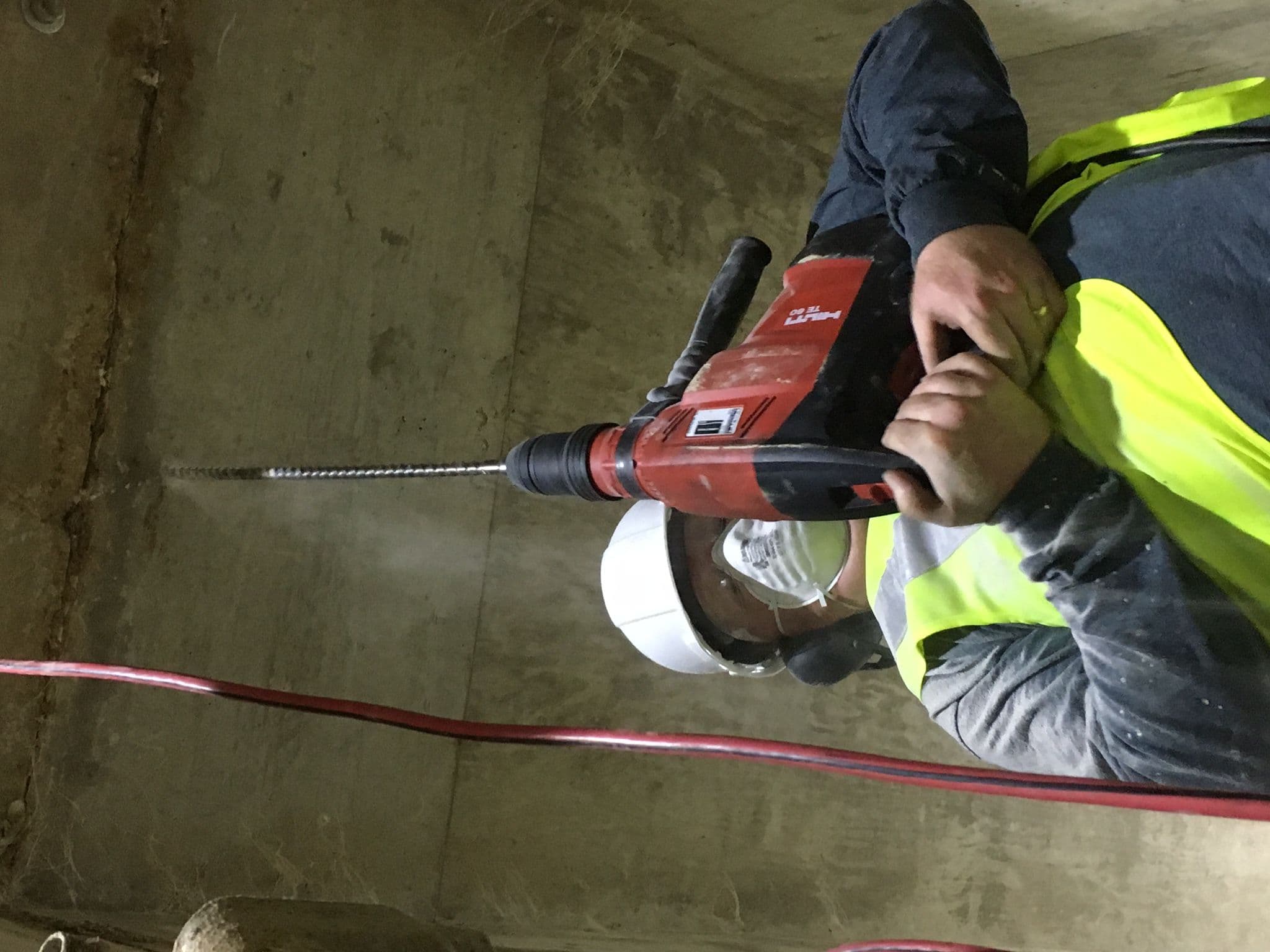
Small holes, as narrow as 5/8 inch, are drilled in a pattern designed around each structure's footprint.
4
Injection
URETEK 486 Star is injected into the weakened soil, expanding up to 20 times its original volume and holding its strength even in saturated ground.
5
Monitoring
Settlement and injection pressure are tracked throughout the work to confirm the fix is reaching the intended depth and area.
6
Validation
The utility or department confirms the structures are stabilized and the station is fully operational before the crew leaves.
URETEK 486 Star holds its strength even when injected into flowing or standing water, which matters at a pump station, where the wet well and surrounding soil are rarely dry. In Clarksville, Indiana, URETEK used this process to stabilize a settled wet well, valve pit, and transformer pad in place, rather than working around the water table.
The soil around a pump station's underground structures is usually saturated, and the material has to perform in that condition, not just in dry, stable ground. That's why hydro-insensitive performance matters more here than on a typical slab or foundation job, where standing water is the exception, not the norm.
In general, yes, since stabilizing the soil in place avoids the excavation, downtime, and rebuild cost of removing and replacing a wet well, valve pit, or transformer pad. A specific dollar figure isn't published for a pump station project yet, so this is a general answer based on how the process works elsewhere, not a pump-station-specific number.
Usually, yes. In Clarksville, Indiana, URETEK stabilized the wet well, valve pit, and transformer pad without removing or relocating them, keeping the pump station's underground structures in place throughout the work.
Often, it's the same soil weakening that affects any buried structure, made worse by a high water table and the constant load a pump station carries. In Clarksville, Indiana, increasing commercial development in the area added flow and load that contributed to settlement beneath the pump station's structures.
Get your wet well, valve pit, or transformer pad assessed by a team that works in saturated ground every day.
Request a Site Assessment
URETEK
Ground improvement solutions engineered for performance.
Contact Us
Find Local Experts


13900 Humble Road, Tomball, TX 77375
Services
Solutions

 800-240-7868


