

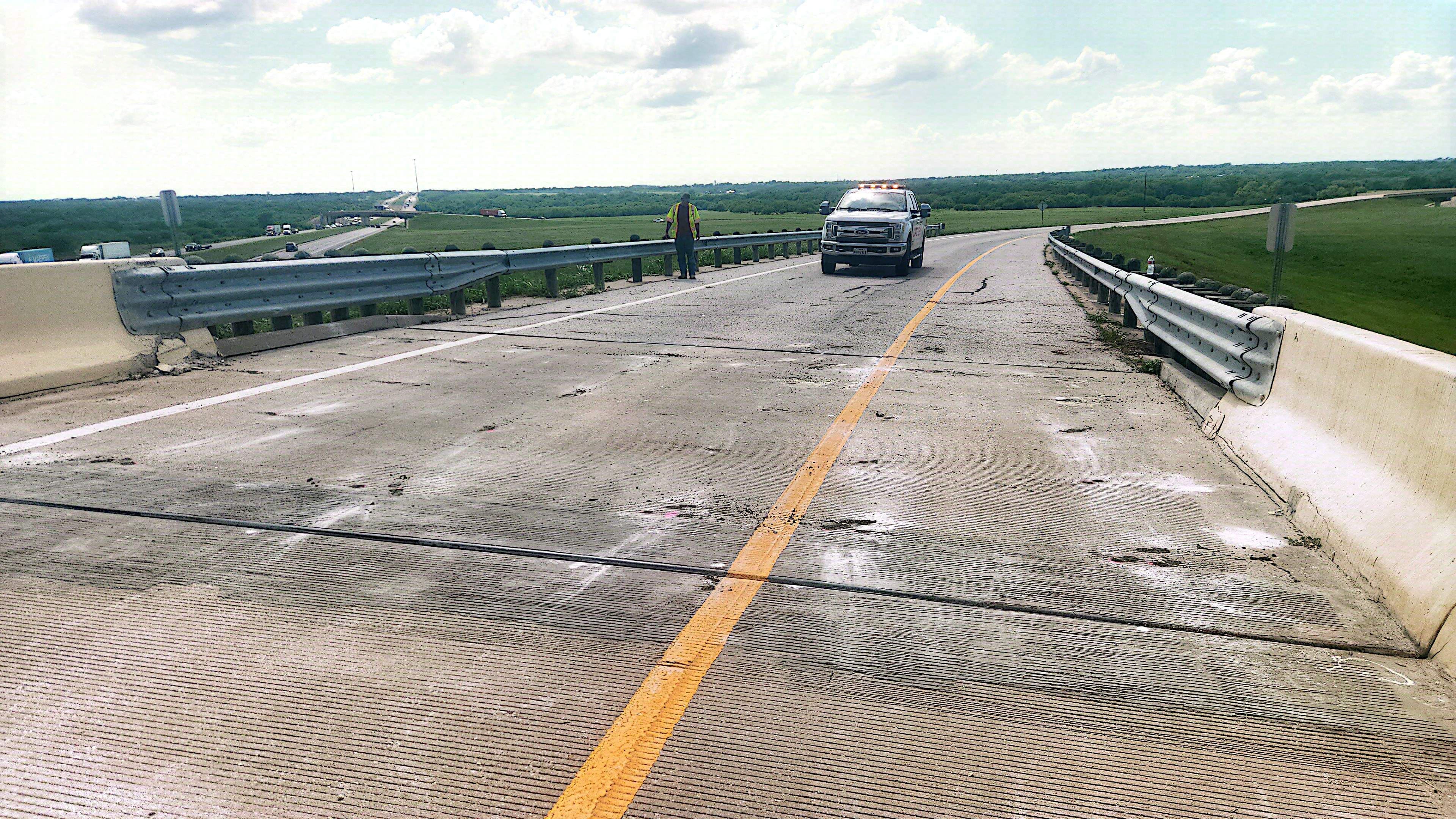
Settled pavement, a dipping foundation, or a structure that has started to tilt usually points to one thing: the soil underneath has lost strength.
Solutions for this Service
Sinkholes

Soil Loss
Weak Soils
Liquefaction Risk
Related Industries
Transportation
Industrial Facilities
Need a Site Assessment?

800-240-7868

Settled pavement, a dipping foundation, or a structure that has started to tilt usually points to one thing: the soil underneath has lost strength. URETEK Deep Injection® (UDI) is a patented, high-density polyurethane injection process that densifies that soil and lifts what sits on top of it back toward its original position. Engineers, private owners, and public agencies use it on roads, runways, foundations, and structures that can't be closed for a full rebuild.

Weak, settled soil doesn't stay a small problem. Here's what it leads to if it's left alone.

Settled or uneven pavement that creates a safety hazard for drivers, aircraft, or pedestrians
Foundations or slabs that have dipped, cracked, or pulled away from adjoining structures
Soft, low-density soil that can't carry the load of a road, building, or piece of heavy equipment
Subsurface voids beneath pavement or structures that keep growing until the surface gives way
Weak soil usually shows itself on the surface before it becomes an emergency. Watch for these.
A dip, depression, or wave in pavement that wasn't there before
Cracks radiating outward from one point on a slab, foundation, or roadway
A structure or slab that has visibly tilted or settled unevenly
A hollow sound or spongy feel when the ground is walked or driven over
Water pooling in one spot after rain, even on ground that should drain evenly
Joints or panels that no longer line up the way they did when built

Why engineers and agencies choose UDI over excavation or full reconstruction.
Handles jobs from a single settled panel to a full runway. URETEK has used UDI to complete over 100,000 projects since 1989, on everything from local driveways to interstate highways and international airports.
Lowers the safety risk that comes with open excavation. Because holes are as small as 5/8 inch, crews aren't working inside a trench next to live traffic or unstable soil, which is the main safety hazard with dig-and-replace repair.
Keeps the road, runway, or facility open. At LAX, URETEK stabilized a terminal and runway section in a single overnight shift, and air traffic resumed on schedule the same morning with no extended closure.
Works nights, weekends, or holidays, and cures fast. URETEK 486 Star® cures to 99% of its strength in minutes, not days, so crews can mobilize on short notice and finish before the next operating shift begins.
Holds its strength even in wet or flowing groundwater. URETEK 486 Star® is hydro-insensitive and expands up to 20 times its original volume once injected, densifying soil that ordinary grout would wash out of before it could cure.
Deep Injection (UDI) is the right call when settled pavement, a dipping foundation, or a sinking structure needs to be lifted back toward grade, or when soil beneath a load simply needs more density and bearing capacity. It's URETEK's flagship, patented process and the one used across the widest range of projects, from highway panels to airport runways to building foundations.
It's not the right tool when the main goal is a water barrier rather than lifting or densifying soil; Curtain Grouting is built for that. It also isn't the first choice when the primary problem is a large, already-formed underground void with little load above it; Void Filling addresses that more directly. For fine-grained soils that need a low-viscosity grout to permeate small pore spaces rather than a high-density polymer, Permeation Grouting is the closer fit.
Deep Injection (UDI) is frequently paired with Concrete Leveling on the same project, since lifting a settled slab back to grade and densifying the soil beneath it are often part of the same repair.
1
Evaluate
A URETEK project manager studies the settlement and reviews soil conditions on site, not a salesperson working from a standard package.
2
Deploy
Crews mobilize on the schedule the site needs, including nights, weekends, or holidays, in a self-contained unit.
3
Drill
Small holes, as narrow as 5/8 inch, are drilled in a pattern designed around the structure's load and the soil testing results.
4
Inject
URETEK 486 Star® is injected and expands up to 20 times its original volume, densifying the soil and lifting the surface above it.
5
Clean Up
There's no excavation to backfill and no trench to restore, so cleanup is minimal.
6
Validate
The client confirms the surface is stable and back to grade before the crew leaves.
URETEK has delivered over 100,000 UDI projects since 1989, from local driveways to interstate highways and international airports.


URETEK 486 Star® cures to 99% of its final strength within minutes, so the fix isn't still settling as it hardens the way a slower material can. Every job starts with a URETEK project manager evaluating the actual soil conditions on site, not a standard package sold regardless of what caused the settlement, and Public Works and Federal projects carry a two-year warranty.
Yes. URETEK 486 Star® is hydro-insensitive, meaning it holds its strength even when injected directly into flowing water, which is not true of every injection material. That matters for sites with a high water table or an active leak feeding the settlement in the first place.
In most cases, yes. On the I-95 project in Cranston, Rhode Island, URETEK completed the repair in 10 days, five days ahead of schedule, at a cost $125,000 under budget, mainly because there was no excavation, no trench restoration, and no extended lane closures to pay for.
Yes. At Los Angeles International Airport, URETEK crews started work at 10 p.m. and had left the site by 6 a.m., with air traffic resuming on schedule the same morning. Crews regularly work nights, weekends, and holidays specifically to avoid closing roads, runways, or facilities during normal operating hours.
UDI is used to lift and stabilize highways and runways, but also building foundations, bridge approaches, tank pads, and other structures wherever weak or settled soil is the underlying cause. The injection depth and pattern are designed around the specific structure and load, not a one-size layout.
Get the soil beneath your road, foundation, or structure evaluated before a small dip becomes a bigger repair. URETEK crews respond fast, including emergencies.
Request a UDI Evaluation
URETEK
Ground improvement solutions engineered for performance.
Contact Us
Find Local Experts


13900 Humble Road, Tomball, TX 77375
Services
Solutions

 800-240-7868


