

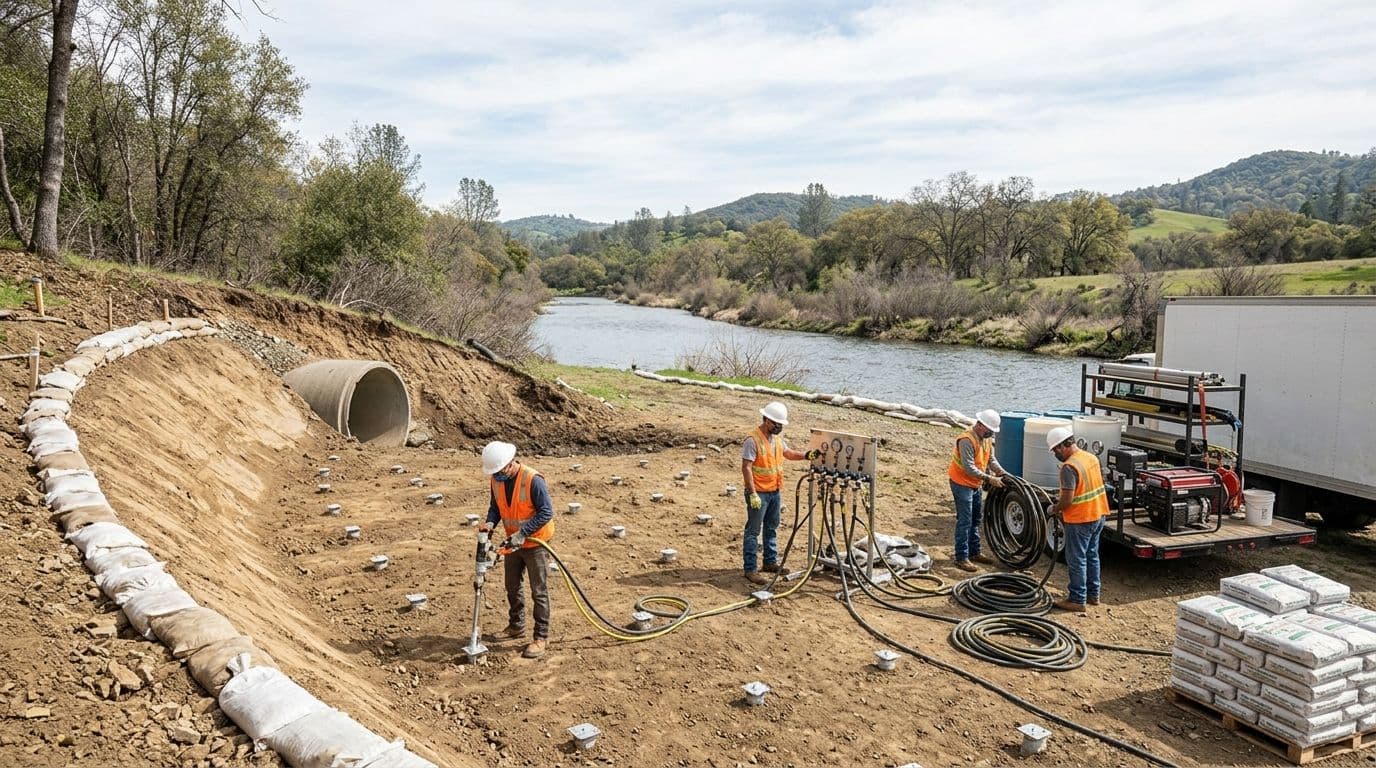
Loose, saturated, sandy soil can temporarily behave like a liquid when seismic shaking increases pressure between its particles. Liquefaction Risk densifies that soil before an earthquake puts it to the test.
Applied in these Services
Liquefaction Mitigation

Related Industries
Transportation
Municipal Infrastructure
Need a Site Assessment?

800-240-7868

Some soil holds up fine under normal conditions and fails during an earthquake for a specific reason: loose, saturated, sandy soil can temporarily behave like a liquid when seismic shaking increases pressure between its particles. Liquefaction Risk densifies that soil in place before a seismic event puts it to the test. Engineers and public agencies in seismic zones turn to it whenever a site's soil has been identified as liquefaction-susceptible.
Liquefaction risk comes down to a specific combination of soil conditions. Here's what makes a site susceptible.

Loose, saturated sandy soil that can temporarily lose strength and behave like a liquid when shaken during an earthquake
A high water table keeping sand or silt soil saturated, increasing its vulnerability during seismic activity
Soil that was never densified or compacted to a level that resists the pressure buildup seismic shaking causes
A site located in a known seismic zone where local geology includes loose, saturated, granular soil layers
Liquefaction risk is usually identified through assessment, not visible damage, since the soil often performs normally until an actual seismic event. Watch for these.
Geotechnical or seismic hazard assessment identifying the site's soil as liquefaction-susceptible
A site located in a mapped seismic hazard zone with known loose, saturated, sandy soil
Building codes or permitting requirements flagging liquefaction mitigation as a condition for new construction or major renovation
A structure in a seismic zone that has never had its foundation soil evaluated for liquefaction risk
Nearby structures on the same soil conditions that experienced settlement or damage after a past seismic event
Insurance, lending, or regulatory requirements calling for a liquefaction risk evaluation before proceeding

This is the right page when the specific concern is how soil will perform during a seismic event, not general bearing capacity or ongoing settlement.
It's not the best fit in every case. Check these first:
 The soil is generally weak, but the concern isn't seismic-specific? See Weak Soils.The soil is loosely packed sand, but the concern is general shifting rather than seismic liquefaction? See Loose Sands.Soil is being actively washed away by water? See Erosion Voids.
A site flagged for liquefaction risk is often loose sand as well. Loose Sands is worth reviewing too, since the two conditions frequently occur together.
What densifying liquefaction-susceptible soil before a seismic event actually gets you.
Reduces soil's susceptibility to liquefying under seismic shaking, addressing the underlying condition directly rather than only reinforcing the structure above it
Reduces the risk of foundation failure, settlement, or structural damage during an earthquake for structures and infrastructure in seismic zones
Can be performed without full excavation, working around an existing structure or site rather than requiring a foundation rebuild
Crews can mobilize on short notice, including nights, weekends, or holidays, so treatment can be scheduled around an active site or facility
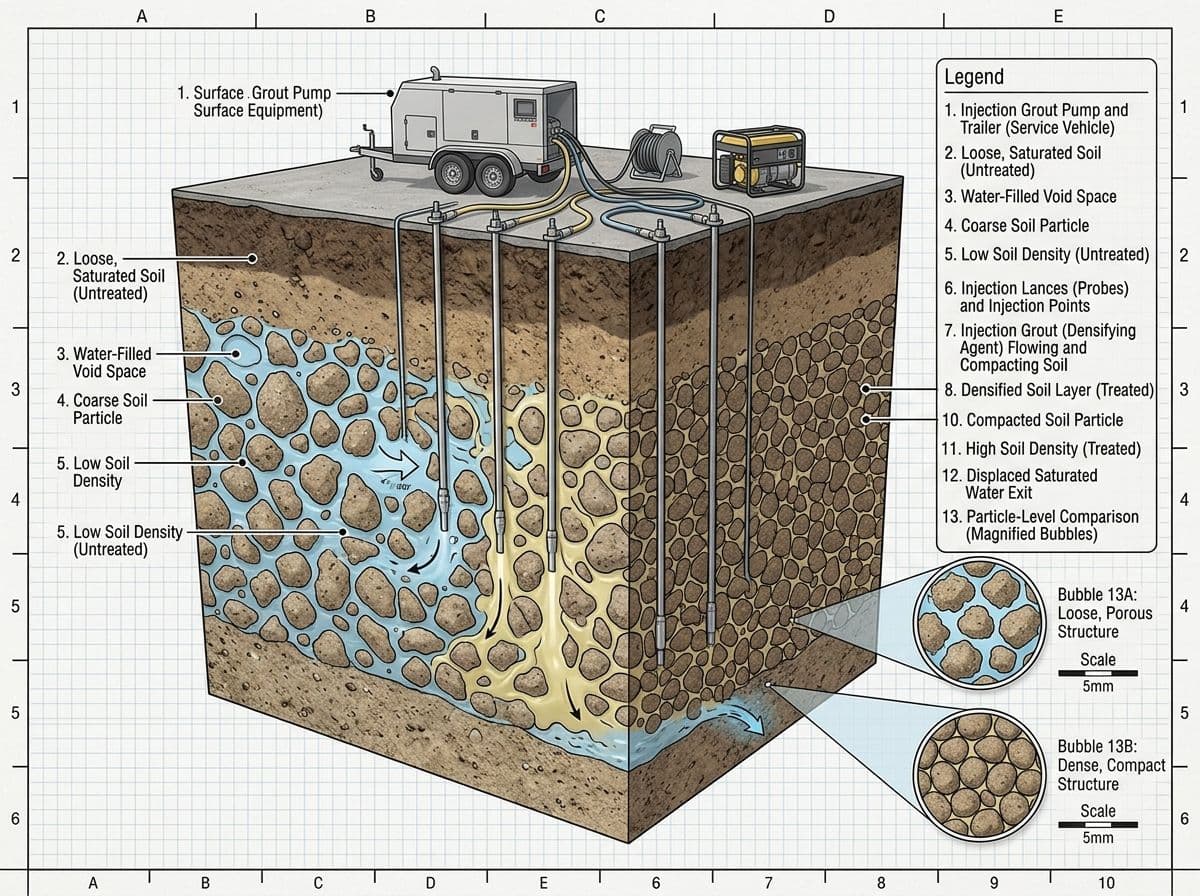
Expanding polymer is injected directly into the soil, increasing its density and reducing the void space between particles, the same characteristic that makes loose, saturated soil vulnerable to liquefying in the first place
Liquefaction Mitigation, the Service, performs this fix directly, targeting the specific soil condition that creates the risk
URETEK's general approach injects polymer or grout directly into loose, saturated soil identified as liquefaction-susceptible, increasing its density and reducing the void space between soil particles, the same characteristic that allows soil to liquefy under seismic shaking in the first place.
This is exactly what the Liquefaction Mitigation service does. It's different from Loose Sands' general shifting concern, and different from Weak Soils' broader bearing-capacity framing.
URETEK densifies liquefaction-susceptible soil for transportation and municipal infrastructure nationwide.






Densifying soil and reducing the void space between particles is the underlying principle engineers rely on to reduce liquefaction susceptibility. Post-treatment testing confirms the improved density meets the specific target set for the site, rather than assuming the treatment worked.
A geotechnical or seismic hazard assessment evaluates soil density, saturation, and grain size to determine liquefaction susceptibility. A treatment plan should be designed around the specific results of that assessment, not a generic approach applied regardless of what the site actually shows.
Addressing soil-level liquefaction risk before a seismic event generally avoids the far larger cost of foundation failure or structural damage afterward, though the specific cost comparison depends on the site and the scope of treatment involved.
In most cases, yes. The injection method works through small access holes rather than requiring full excavation, the same approach used for other soil density improvements without disturbing what's built above.
Loose, saturated, granular soil like sand can temporarily lose its strength and behave like a liquid when seismic shaking increases water pressure between soil particles. Soil that's already dense, or soil that isn't saturated, is far less prone to this effect.
Get liquefaction-susceptible soil densified before a seismic event puts it to the test.
Request a Liquefaction Risk Assessment
URETEK
Ground improvement solutions engineered for performance.
Contact Us
Find Local Experts


13900 Humble Road, Tomball, TX 77375
Services
Solutions

 800-240-7868


