

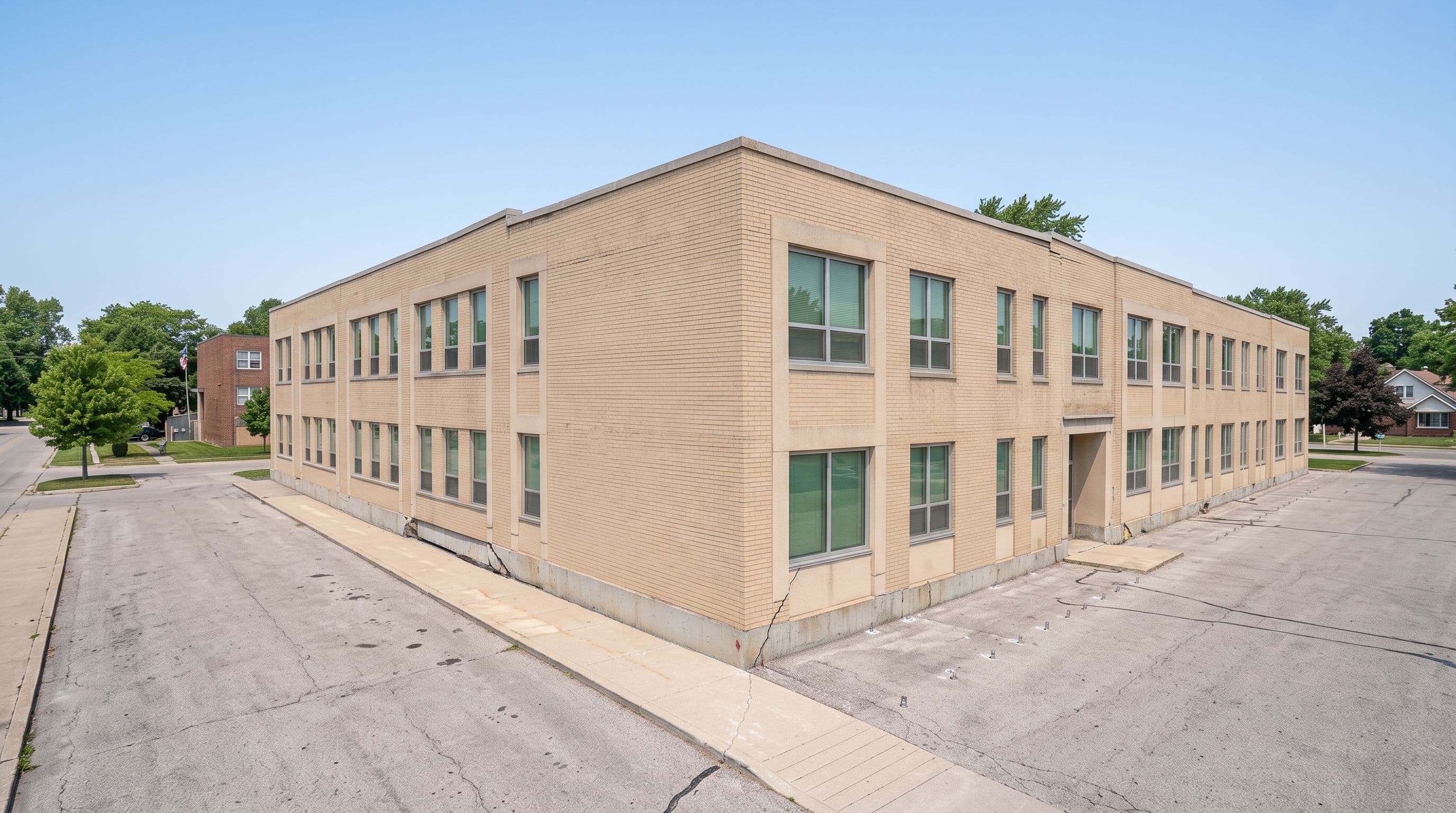
A crack near one corner, a slope on the far side of the building, a door that's stuck for years, when more than one part of a structure is out of level, fixing a single spot doesn't solve the problem.
Applied in these Services
Structural Re-leveling

Related Industries
Commercial and Institutional
Municipal Infrastructure
Need a Site Assessment?

800-240-7868

Some settlement doesn't stay in one place. A crack near one corner, a slope on the far side of the building, a door that's stuck for years on end. When more than one part of a structure is out of level at once, fixing a single spot doesn't solve the problem, the rest keeps moving. Structural Re-Leveling coordinates correction across every affected point of a structure at once. Engineers, building owners, and facility managers turn to it when settlement has spread beyond a single area.
A structure rarely settles evenly everywhere at once. Here's why more than one point tends to move.

Soil strength varies across a building's footprint, so different sections settle at different rates even under the same structure
Additions built onto an older structure sit on different foundations than the original, and each responds differently to the same ground conditions
Water intrusion or poor drainage affects one side or corner of a building more than the rest, weakening the soil unevenly
Fill material used when the structure was originally built, sometimes rubble, debris, or reclaimed land, was inconsistent in depth or composition and settles unevenly as it continues to consolidate
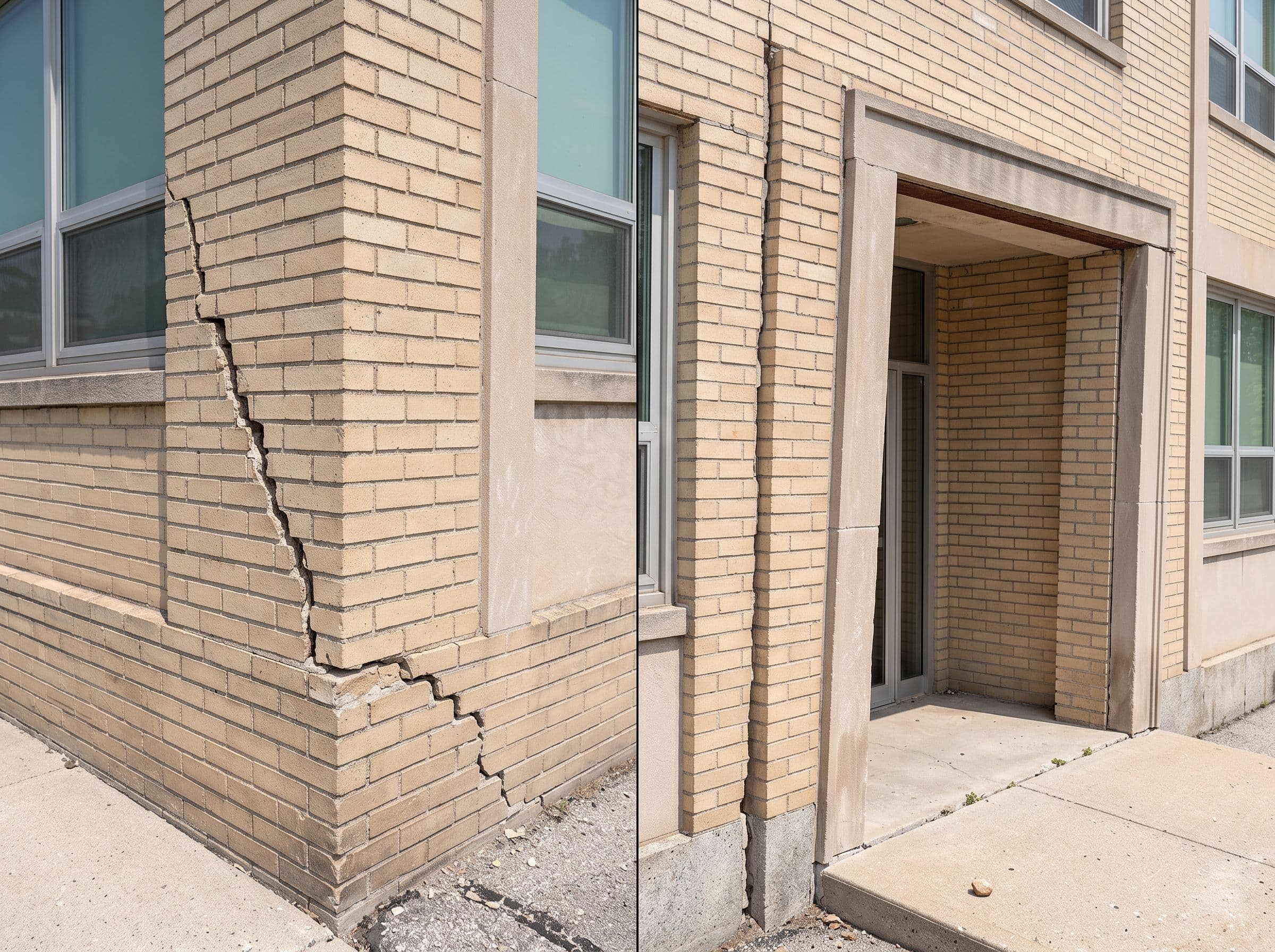
A single crack is easy to notice. A structure moving at more than one point often shows up more gradually. Watch for these.
Floors that slope in more than one direction, not just toward a single wall
Doors and windows out of square on multiple sides of the building, not just one
Visible gaps or separations between different sections or additions of the same structure
Cracks appearing in more than one location, often running at different angles
The structure looking visibly tilted or out of level from the outside
A previous single-point repair that didn't stop the rest of the structure from continuing to shift
This is the right page when more than one point across a whole structure is out of level, not just a single slab, floor, or wall.
It's not the best fit in every case. Check these first:
 Just one slab, floor, or paved area, not the whole structure? See Concrete Leveling.Concerned about a foundation's capacity for new or added load, not yet visibly tilted? See Foundation Stabilization.Settlement hasn't yet been narrowed down to a specific pattern across the structure? See Settlement Remediation.
A multi-point settlement problem often shows up alongside a stressed retaining wall or a forming void nearby. Worth checking Retaining Wall Stabilization and Void Formation too.
What coordinating the whole structure, instead of one area at a time, actually gets you.
Addresses every affected point in one project, instead of fixing one corner and leaving the rest to keep moving until it needs its own repair later
Reduces the safety risk of uneven settlement reaching load-bearing walls, connections, or historic masonry before it's caught and corrected
Keeps the structure in use. On the Cincinnati, Ohio hotel project, URETEK completed the repair in a single day, with minimal disruption to daily operations
Measured in days, not months, even across multiple points. The U.S. Air Force Academy medical clinic project stabilized the foundation slab in just two days, restricted to a single weekend
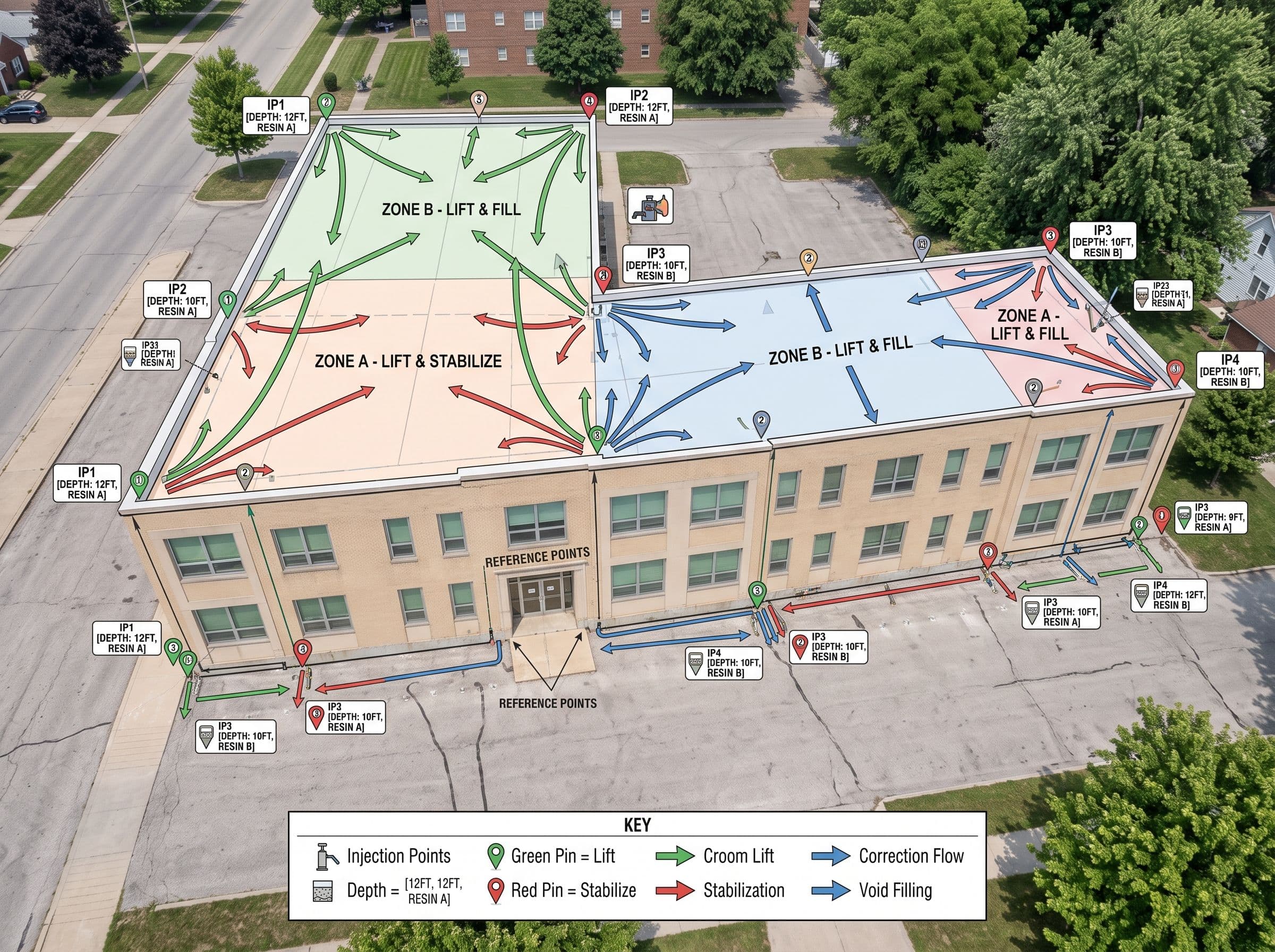
The injection sequence is engineered across the full footprint before work starts, so each point is raised and supported to a consistent elevation instead of independently, one at a time
Structural Re-leveling, the Service, performs this multi-point correction directly, coordinating every affected area of a structure as part of the same plan
URETEK's approach engineers the injection sequence across the whole structure before drilling starts. Crews inject expanding polymer at each affected point, in an order planned so correcting one area doesn't undo or disturb work already completed elsewhere in the same structure. There's no excavation, and no need to treat each point as a separate, unrelated repair.
This is exactly what the Structural Re-leveling service does. It coordinates correction across every affected point of a single structure, unlike Concrete Leveling's single-slab focus or Foundation Stabilization's general bearing-capacity fix.
URETEK has re-leveled museums, hotels, and public facilities nationwide, coordinating correction across every affected point of a structure.
URETEK plans the injection sequence across the whole structure before work starts, so pressure changes at one point don't undermine an area that isn't part of the same coordinated plan. That is the difference between re-leveling a structure as a whole and patching one corner at a time.
Soil testing across the full footprint identifies which areas have lost strength and by how much. The injection sequence is then planned so work at one point doesn't disturb ground that has already been corrected elsewhere in the same structure.
In most cases it's more cost-effective, since one mobilization and one coordinated plan replaces what would otherwise be several separate repair visits as new areas of the structure show problems over time.
In most cases, yes. On the U.S. Air Force Academy medical clinic project, URETEK stabilized the foundation slab in just two days, restricted to a single weekend, so the facility's normal operating schedule was preserved.
Age itself isn't the deciding factor, what matters is how the original foundation and any later additions were built. At the Field Museum of Chicago, URETEK's non-intrusive polymer injection stabilized the ground floor in just three days without disturbing the historic structure above.
Get every affected point of your structure assessed and corrected together.
Request a Structural Assessment
URETEK
Ground improvement solutions engineered for performance.
Contact Us
Find Local Experts


13900 Humble Road, Tomball, TX 77375
Services
Solutions

 800-240-7868


