

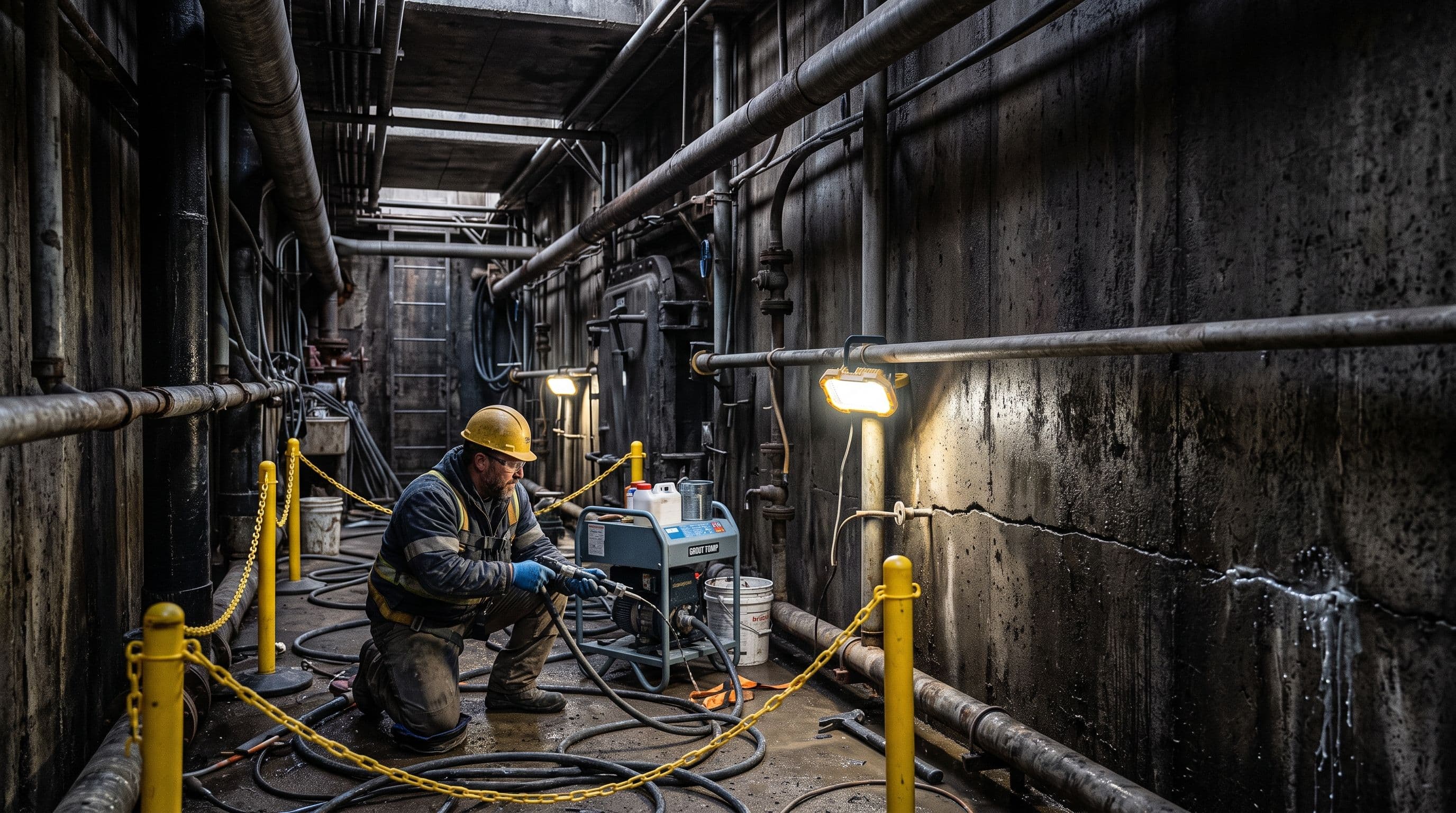
Water finds its way through cracks and joints long before anyone notices, and the soil it carries with it goes with it.
Solutions for this Service
Active Water Intrusion

Pipe Penetration Leaks
Weak Soils
Erosion Voids
Related Industries
Water and Wastewater
Municipal Infrastructure
Need a Site Assessment?

800-240-7868

Water finds its way through cracks and joints long before anyone notices, and the soil it carries with it goes with it. Chemical Grouting injects a low-viscosity resin, matched to the specific soil and water condition, directly into the ground to seal that path and rebuild strength from below, without excavation. Engineers, facility owners, and public agencies use it on tunnels, vaults, joints, and below-grade structures where water intrusion and weak soil threaten what's built above.
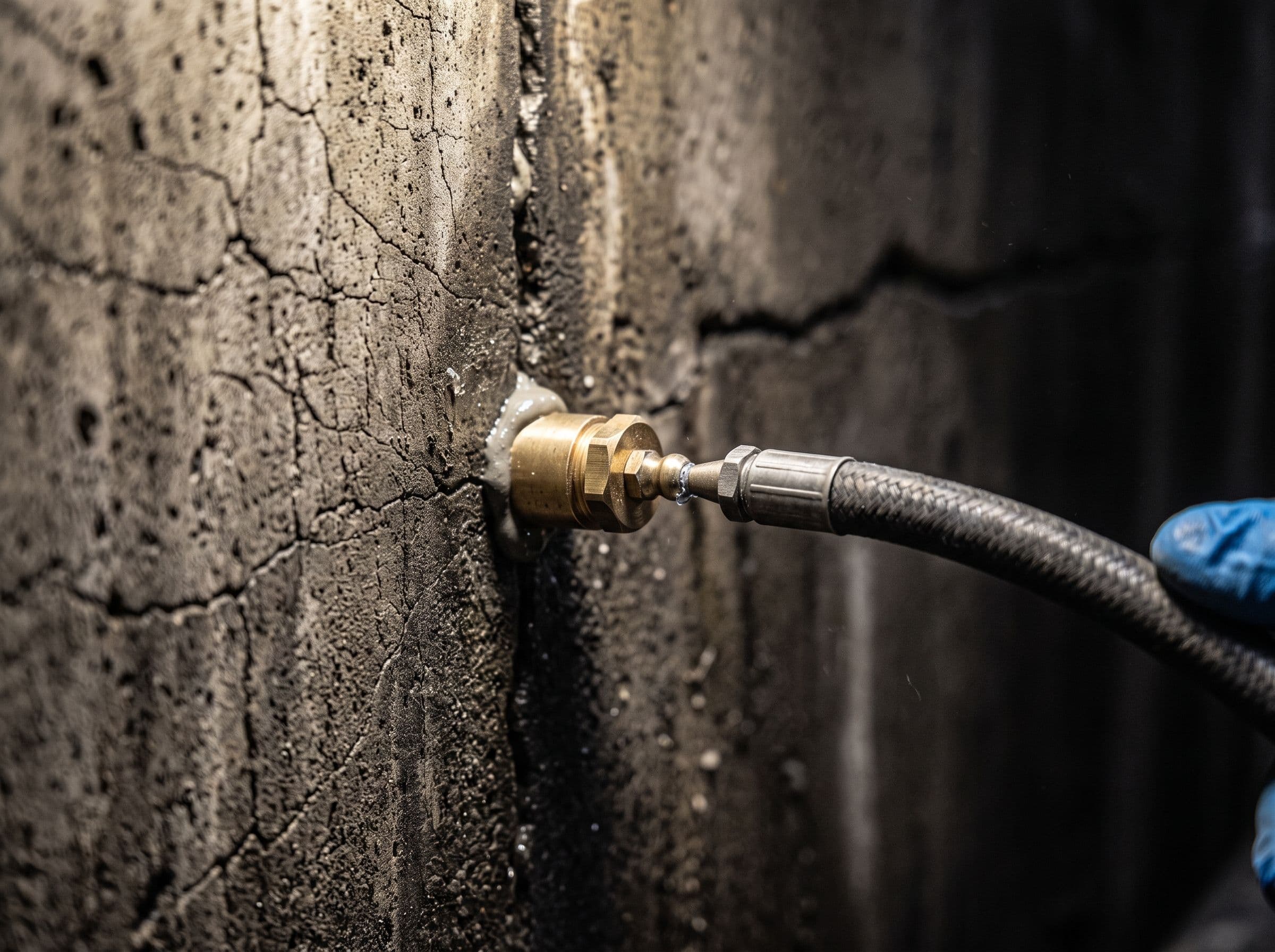
Water intrusion and weak soil don't stay separate problems for long. Here's what they lead to if they're not sealed and stabilized.

Water infiltration through cracks, joints, and below-grade walls that erodes soil and undermines structures
Fine, granular soil losing strength as water continues to move through it
Groundwater finding its way around pipes, utilities, and annular spaces that weren't fully sealed at installation
Ongoing soil loss beneath slabs and structures that keeps the underlying problem growing
Water and weak soil usually show themselves before a structure fails outright. Watch for these.
Water seeping through a below-grade wall, tunnel lining, or vault joint
Staining, efflorescence, or mineral buildup where water has been passing through concrete or masonry
Soil settling or washing out around a pipe, manhole, or utility penetration
A joint or annular space around a pipe that was never fully sealed at installation
Soft or eroding soil beneath a slab near a known water source
Persistent dampness in a below-grade space with no obvious surface cause
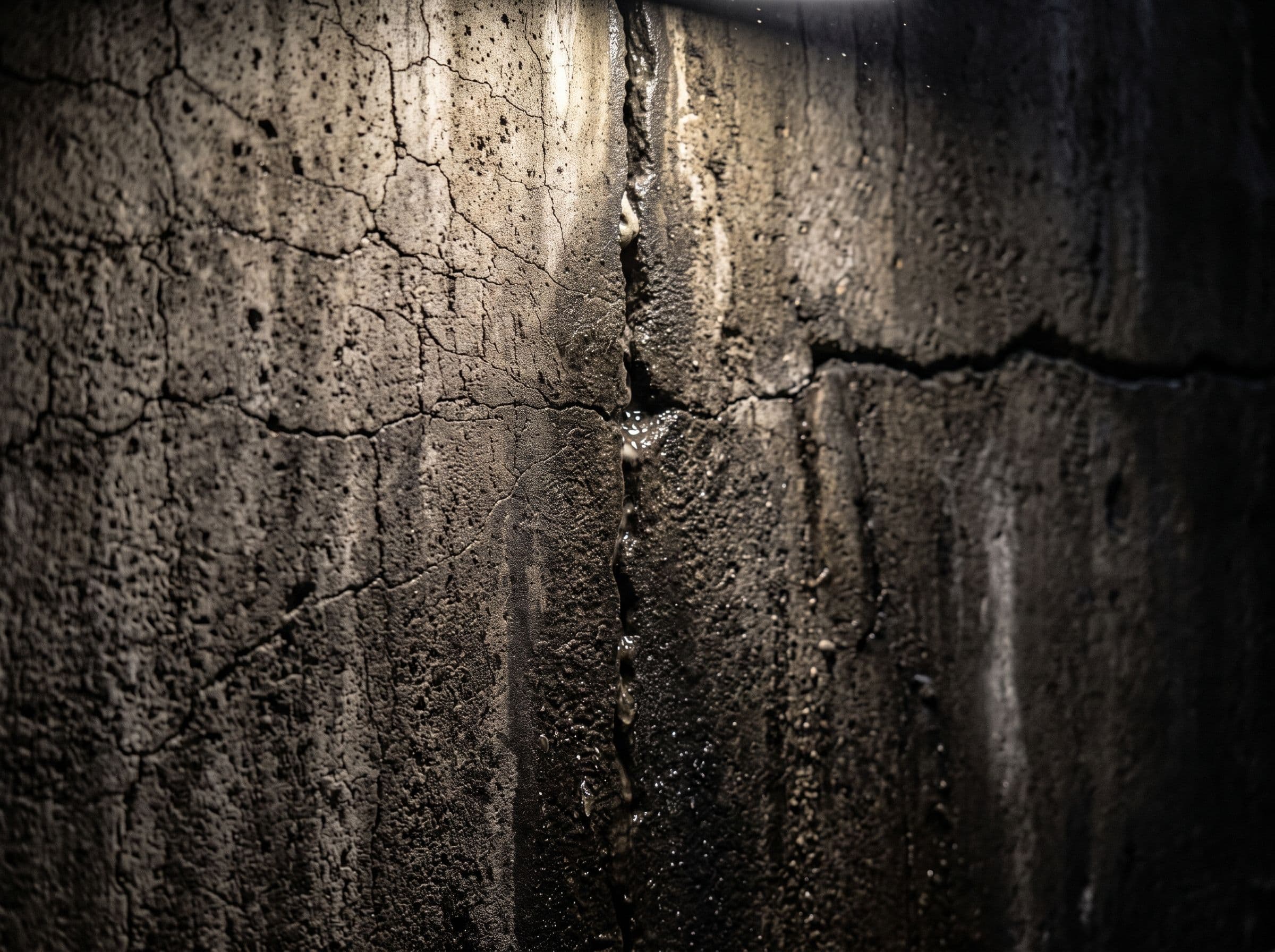
Why engineers and agencies choose Chemical Grouting for sealing and soil stabilization.
Matches the material to the problem instead of using one grout for everything. URETEK selects from acrylate gels, single-component polyurethanes, and urea-silicates depending on the soil type, water condition, and whether the goal is sealing, binding, or both.
Addresses water intrusion before it undermines a structure. Sealing the path water is taking through a joint, wall, or soil layer stops the erosion cycle that leads to voids and settlement.
Keeps occupied and operating sites undisturbed. On a deep excavation next to an occupied three-story building in Pelham, New York, URETEK's work resulted in no recordable settlement at the adjacent structure.
Results are tested, not assumed. Rising-head permeability testing before and after grouting confirmed a 95% reduction in groundwater infiltration on a wastewater treatment project near Lake Erie, Ohio.
The grout permeates soil pore spaces rather than displacing them. Unlike URETEK's expanding polymer used in Deep Injection, chemical grout flows into the natural pore spaces of fine and granular soil, binding the soil grains together into a watertight, stabilized mass.
Chemical Grouting is the right call when the problem is water finding its way through a joint, wall, or granular soil layer, and the goal is sealing that path and stabilizing the soil around it using a material matched to the specific condition. It's built for tunnel and vault waterproofing, manhole and pipe joint sealing, below-grade leak repair, and groundwater cutoff around pipes and utilities.
It's not the right tool when the goal is a single, continuous vertical barrier along a defined excavation or floodwall line rather than treating a specific joint or leak; Curtain Grouting is the more precise fit for that line-item work, even though it often uses the same acrylate material. It also isn't the fit when soil needs to be displaced and densified for bearing capacity rather than sealed through permeation, which Compaction Grouting is built to do, or when the scale of the job calls for URETEK's core high-density polyurethane lifting settled structures, which is Deep Injection (UDI)'s role.
Chemical Grouting is often paired with Curtain Grouting on the same site when a project needs both targeted joint and leak sealing and a continuous groundwater barrier along an excavation line.
1
Investigation
A URETEK project manager investigates the source of water intrusion and the condition of the surrounding soil, not a salesperson working from a standard package.
2
Planning
The grout type and injection pattern are planned around the specific soil, water, and structural conditions found during investigation.
3
Access
Small access points are established at the joint, wall, or soil zone requiring treatment.
4
Injection
The selected chemical grout, acrylate gel, single-component polyurethane, or urea-silicate, is injected to seal and stabilize the treatment area.
5
Monitoring
Injection pressure and flow are monitored throughout to confirm the grout is reaching the intended area.
6
Validation
Results are confirmed, often with permeability or settlement testing, before the job is closed out.
URETEK has sealed groundwater paths for wastewater plants, transportation authorities, and municipal clients nationwide, with results confirmed by real testing.




Results are tested, not assumed. On a wastewater treatment excavation near Lake Erie, Ohio, URETEK's chemical grout curtain achieved a 95% reduction in groundwater infiltration with zero recorded settlement. On a coastal service building supporting a New York City bridge, treated areas stayed fully dry through observed tidal cycles, verified with rising-head permeability testing before and after grouting.
URETEK selects from three grout types based on the specific soil and water condition: acrylate gels for fine, low-permeability sealing; single-component polyurethanes for expanding, moisture-reactive applications; and urea-silicates for soil binding and encapsulation. The right material depends on grain size, water flow, and what the grout needs to accomplish, sealing, binding, or both.
It depends on the site, but on the Lake Erie wastewater project, jet grouting was evaluated and ruled out in favor of chemical grouting, which achieved the needed groundwater control without the vibration and access requirements jet grouting would have carried. A site-specific comparison is the only way to confirm the number for a given project.
Yes. On a deep urban excavation in Pelham, New York, next to an occupied three-story building, URETEK's grout curtain and underpinning work resulted in no recordable settlement at the adjacent structure. On the Lake Erie project, treatment was completed without interrupting the adjacent aeration tanks' operation.
Chemical Grouting is used for tunnel and vault waterproofing, manhole and pipe joint sealing, below-grade leak repair, soil stabilization under slabs, groundwater cutoff, and sealing the annular space around pipes and utilities.
Get a leak or weak soil condition sealed before it undermines what's built above it. URETEK crews respond fast, including emergencies.
Request a Chemical Grouting Evaluation
URETEK
Ground improvement solutions engineered for performance.
Contact Us
Find Local Experts


13900 Humble Road, Tomball, TX 77375
Services
Solutions

 800-240-7868


