

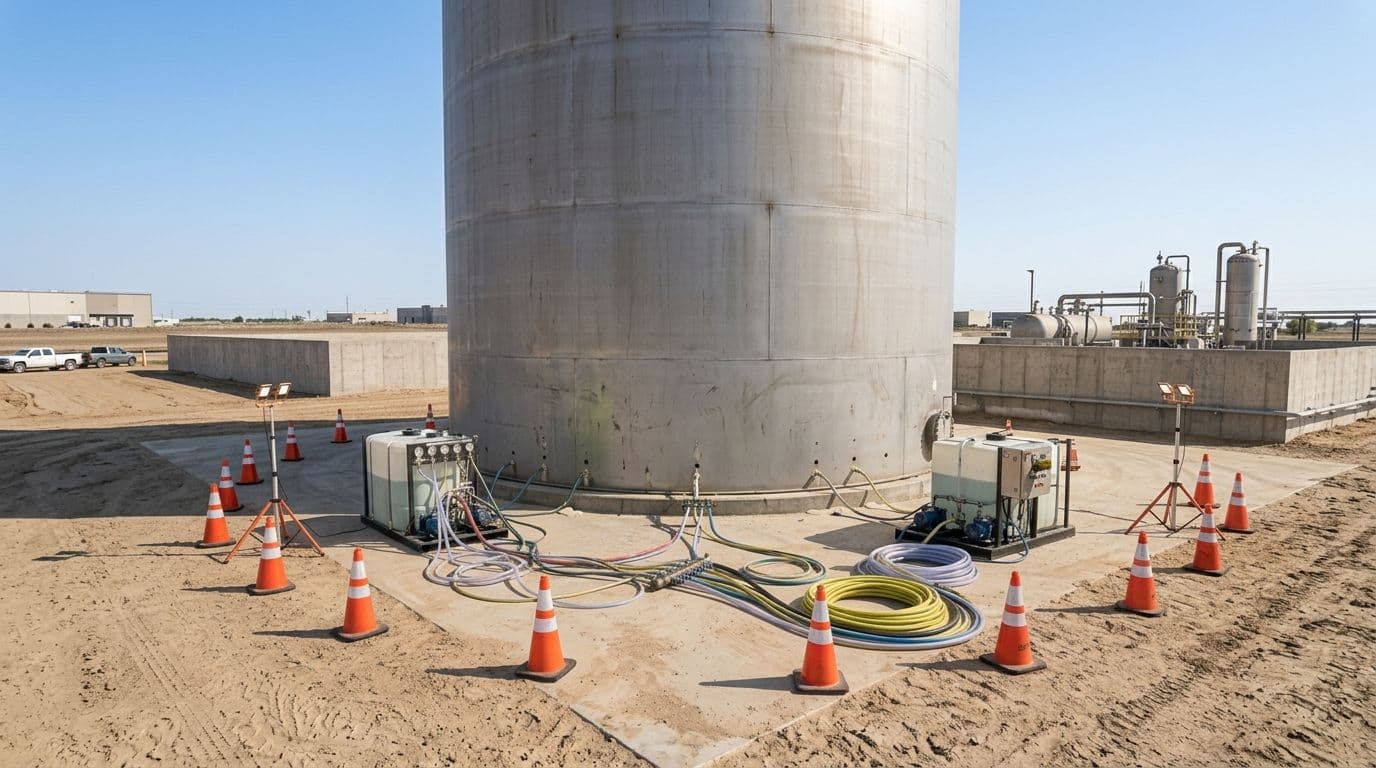
A storage tank puts constant, concentrated weight on one small footprint of ground. Tank Pad Stabilization strengthens that soil in place, without taking the tank out of service.
Solutions for this Service
Settlement Remediation

Foundation Stabilization
Weak Soils
Loose Sands
Related Industries
Industrial Facilities
Power and Energy
Need a Site Assessment?

800-240-7868

A storage tank puts constant, concentrated weight on one small footprint of ground. When the soil beneath that footprint weakens or settles unevenly, the pad cracks, tilts, or pulls at the piping connected to it. Tank Pad Stabilization strengthens that soil in place, without taking the tank out of service. Engineers, facility owners, and public agencies use it when a tank can't come offline for a rebuild.
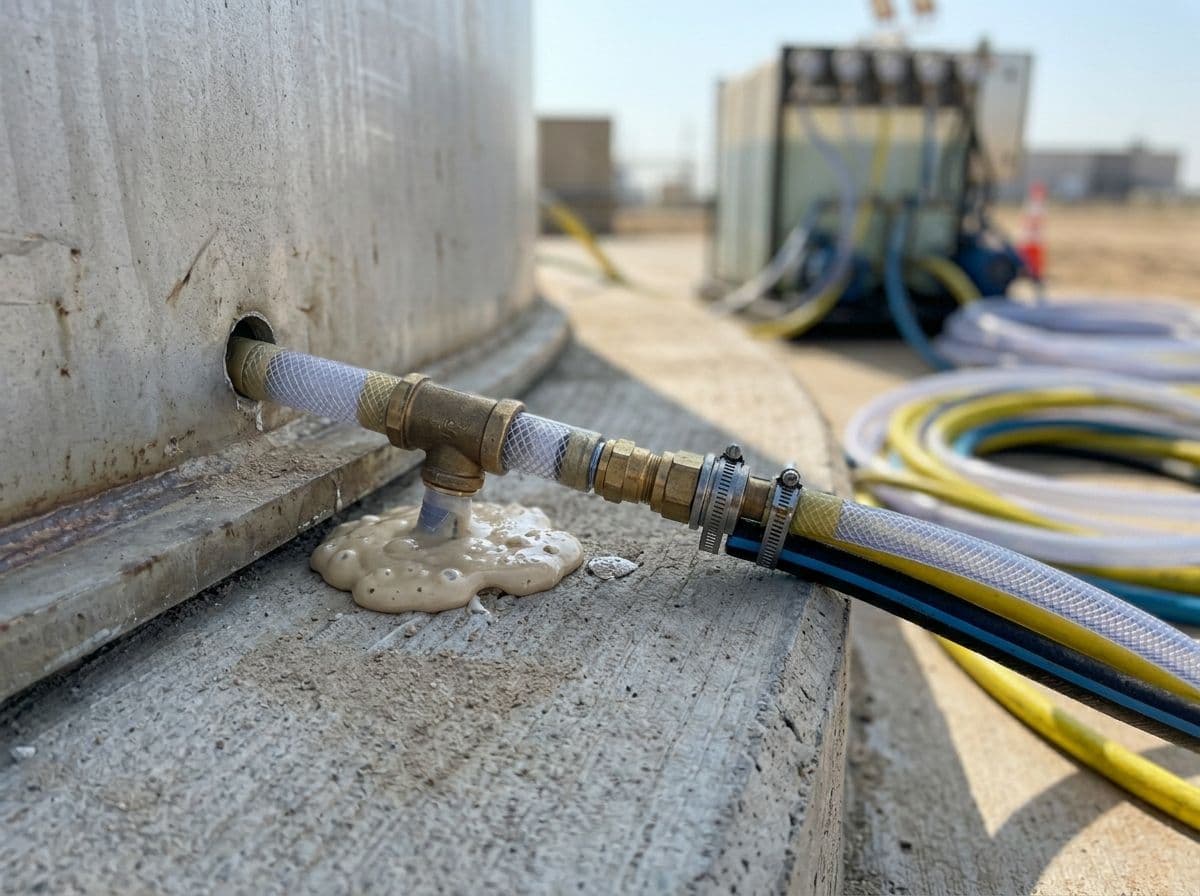
Weak soil under a tank pad doesn't stay hidden for long. Here's what it leads to if it's not fixed.

Differential settlement that tilts the tank pad and puts stress on inlet, outlet, and pipe connections
Cracking or separation of the tank pad from surrounding grade, slabs, or containment walls
Loss of containment risk when foundation movement pulls a tank out of level or breaks a seal
Ongoing soil loss beneath the pad from erosion, washouts, or groundwater flow that keeps the problem growing
A tank pad usually shows warning signs before it fails. Watch for these.
A tank that looks tilted or no longer sits level on its pad
Cracks running through the concrete pad, especially near the tank's edge or anchor bolts
Gaps opening between the tank pad and nearby piping, containment walls, or slabs
Soft or spongy ground around the base of the tank after rain
Pipe connections at the tank showing new stress, misalignment, or leaks
A pad that has visibly sunk or shifted compared to when the tank was installed
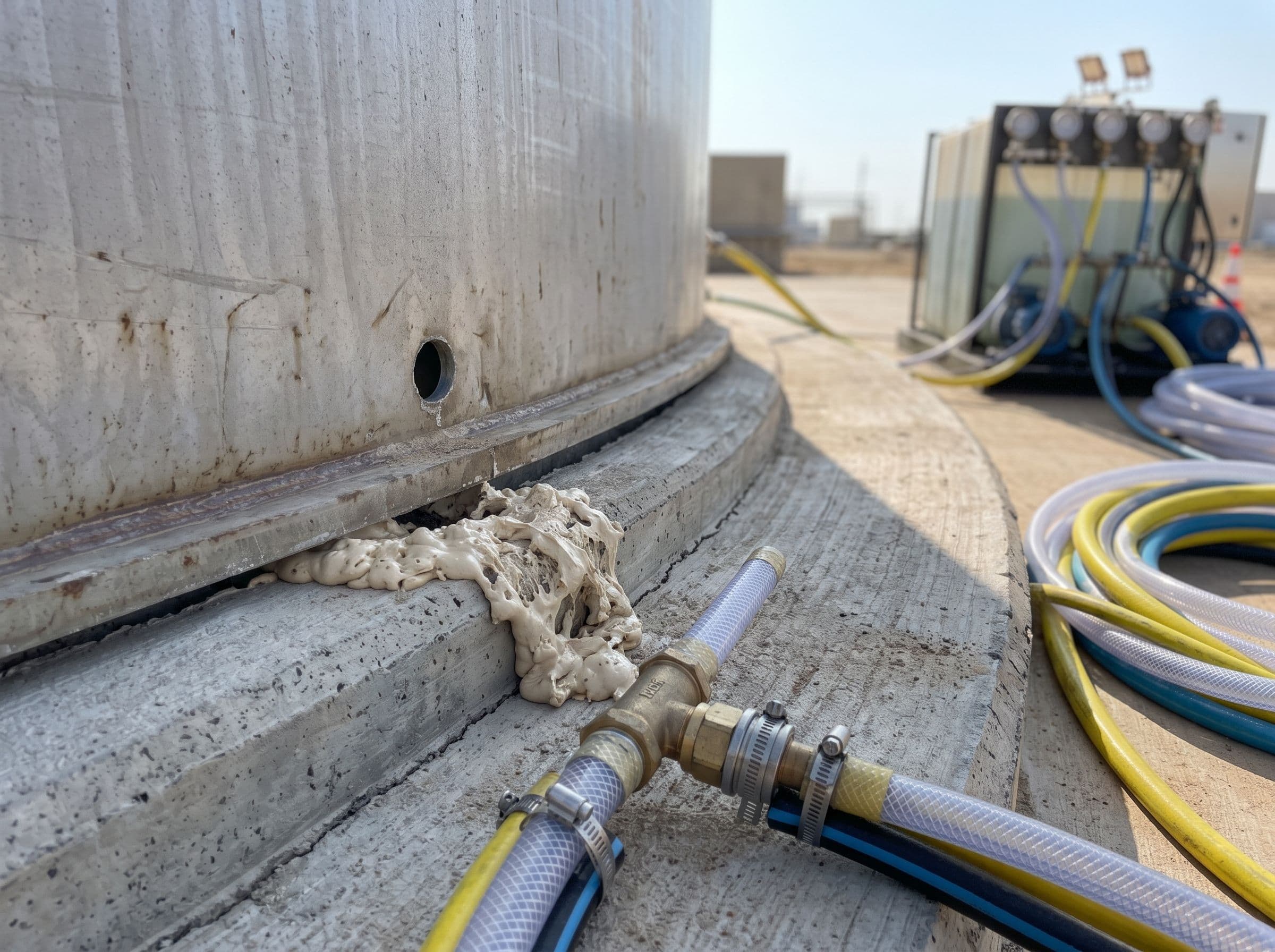
Why facility owners and engineers choose Tank Pad Stabilization over rebuilding.
Reaches weak soil beneath a loaded tank without taking the tank out of service. URETEK 486 Star® polymer is injected through holes drilled around or through the pad, reaching soil a tank's own weight makes impossible to dig out and replace.
Lowers the risk of a containment failure. Stabilizing the soil before a pad cracks or tilts protects against the spills and environmental exposure a sudden foundation failure can cause, which matters most for chemical, fuel, and oil storage tanks.
Keeps the tank in service during the work. Because the pad is stabilized from outside the tank shell, the storage, production, or water delivery tied to that tank doesn't have to stop.
Cures to 99% of its strength within minutes, and crews mobilize nights, weekends, or holidays. The work fits around a facility's production schedule instead of forcing a shutdown to accommodate the repair.
The polymer expands to fill the soil's actual weak spots, not just the space directly under the pad. URETEK 486 Star® is a two-part polyurethane that expands up to 20 times its original volume once injected, compacting loose or eroded soil back to a bearing capacity that can carry the tank's load.
Tank Pad Stabilization is the right call when the soil beneath a tank foundation has weakened, settled unevenly, or lost material to erosion or groundwater, and the tank itself is otherwise sound. It's built for storage tanks, silos, and heavy equipment pads across oil, gas, chemical, water, and food-processing facilities.
It's not the right tool when the pad's concrete has failed structurally rather than the soil beneath it; for that, Structural Underpinning is the better starting point. It also isn't the fix for active water intrusion into a below-grade tank vault, where Curtain Grouting is the more direct answer.
Tank Pad Stabilization is often paired with Curtain Grouting when groundwater flow is the reason the soil kept losing strength in the first place, since sealing the water path stops the settlement from returning after the pad is stabilized.
1
Evaluate
A URETEK project manager reviews the tank, the pad, and the soil conditions on site, not a salesperson pushing a standard package.
2
Deploy
Crews mobilize on the schedule the site needs, including nights, weekends, or holidays, in a self-contained unit.
3
Drill
Small holes are drilled around or through the pad in a pattern designed around the tank's load and the soil's condition.
4
Inject
URETEK 486 Star® polymer is injected beneath the pad, expanding to fill voids and compact the surrounding soil.
5
Clean Up
There's no excavation to backfill, so cleanup is minimal and the site is left ready for the tank to keep running.
6
Validate
The client confirms the pad is stable and level before the crew leaves.
URETEK has stabilized tank pads for dairy, food processing, and industrial facility owners nationwide, with results still holding years after the work was done.

URETEK 486 Star® cures to 99% of its final strength within minutes, so it isn't a slow-setting material that keeps shifting after the crew leaves. A tank pad URETEK stabilized in Murray, Kentucky was checked again 15 years later and was still holding, and Public Works and Federal projects carry a two-year warranty on top of that.
The drilling pattern and injection depth are designed around the tank's footprint, weight, and the site's specific soil report, not a standard layout borrowed from pavement work. Because URETEK 486 Star® expands to fill the exact shape of a void or weak zone, it compacts the soil to match the bearing capacity the tank actually needs, not a generic target.
In most cases, yes, since there's no excavation, no new pad to pour, and no tank to move off its foundation. A dairy processing facility in Kentucky has gone more than two years since URETEK's work with no additional settlement detected, without the cost of removing and rebuilding the pad.
Yes. Because the polymer is injected through small holes drilled around or through the pad, the tank itself stays in place and in service. Crews can also work nights, weekends, or holidays, which matters for water utility and public agency tanks that can't be taken offline during normal operating hours.
Tank Pad Stabilization is used under storage tanks for oil, gas, chemicals, and water, as well as grain silos, clarifiers, and other heavy processing equipment where the concern is the soil underneath, not the structure itself.
Get the soil beneath your tank evaluated before settlement turns into a containment problem. URETEK crews respond fast, including emergencies.
Request a Tank Pad Assessment
URETEK
Ground improvement solutions engineered for performance.
Contact Us
Find Local Experts


13900 Humble Road, Tomball, TX 77375
Services
Solutions

 800-240-7868


