

Written By Admin
|
Published on 8/12/2026
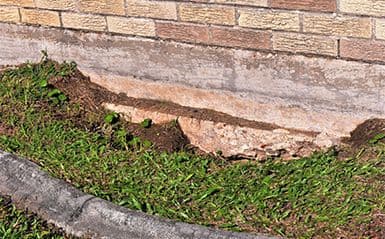
When it comes to making foundation repairs beneath the surface of your home, it's natural to wonder about how the repair method you choose impacts the Earth. The different methods used for concrete foundation repair vary in their approach and impact on the environment.
Let's take a closer look at commonly used foundation repair methods and their environmental implications:
1
1. Mudjacking: A Traditional Approach
Mudjacking involves pumping a mixture of soil, water, and cement beneath a settled concrete foundation to raise it. While effective in restoring immediate stability, this method may result in soil displacement and potential contamination.
2
2. Concrete Pressed Piling: Solidifying Foundation Support
Concrete pressed piling involves driving precast concrete cylinders into the ground to support and stabilize the foundation. It is a reliable method that minimizes soil disturbance and has a relatively low environmental impact.
3
3. Steel, Helical, and Concrete Piers: Reinforcing Stability
Using steel, helical, or concrete piers involves driving or drilling supports into the ground to reinforce the foundation. While effective, this method often requires excavation, which can disrupt the surrounding environment.
4
4. Polyurethane Foam Injection: Precise and Minimally Disruptive
Polyurethane foam injection, or URETEK Deep Injection® (UDI), is an innovative, eco-friendly approach. URETEK 486 Star Polymer expands underground to lift and stabilize the foundation, with no excavation, minimal soil disturbance, long-lasting results.
At URETEK, we conduct our work with care for the environment. Here's what that means in practice.
 Our process, URETEK Deep Injection® (UDI), is minimally invasive.Our patented 486® Star Polymer is non-toxic and non-hazardous, so it interacts safely with ground and water systems.The polymer is non-CFC and non-HFC, so it does not contribute to ozone depletion or release harmful substances.The polymer is environmentally neutral. It does not contaminate soil or water.
When considering foundation repair options, it's essential to choose a method that not only addresses structural concerns but also aligns with your environmental values. Be sure to prioritize methods that leave the smallest overall footprint and provide the longest-lasting results. By selecting URETEK for your foundation repair needs, you can have peace of mind knowing that your home is being restored while minimizing the impact on the Earth.
For more on what makes the URETEK Deep Injection Process different, visit Our Process page.
URETEK's 486® Star Polymer is non-toxic and non-hazardous, and it's environmentally neutral, meaning it doesn't contaminate soil or water. It's also non-CFC and non-HFC, so it doesn't release ozone-depleting substances.
Mudjacking and piers usually involve some soil displacement or excavation. Polyurethane foam injection (URETEK Deep Injection®) requires no excavation and causes minimal soil disturbance, since the polymer is injected through small holes and expands underground.
Because the process doesn't require excavation, the surface above stays largely undisturbed during the work, unlike methods that involve digging or driving piers into the ground.
Discover how URETEK's eco-friendly foundation repair process protects your home and the environment.
Request a Foundation Assessment
URETEK
Ground improvement solutions engineered for performance.
Contact Us
Find Local Experts


13900 Humble Road, Tomball, TX 77375
Services
Solutions

 800-240-7868

